
Turkish artist and writer Benan Bilek brings traditional arts together with a contemporary and deeply personal form of expression. Alongside her works created with thread on embroidery hoops and traditional flour sieves, she has also developed a distinctive body of work in ceramic tile art. Everyday objects, historical motifs and human stories stand at the centre of her artistic practice. Her creative world also extends into literature, with published books including Çin Çin Çini Mini Hanım, Punta – Bir Meyhanenin Romanı, Duvarlar Şahit, Rezene, Limon Çekirdeği and Küçürek Bir Aşk. In Bilek’s work, thread, ceramic pigments and words become different ways of exploring memory and the traces that life leaves behind.
An artist’s table may be covered with threads, embroidery hoops, tile pigments and unfinished patterns. A writer’s desk, meanwhile, may hold notebooks, character sketches and sentences waiting to be completed. In Benan Bilek’s world, these two desks are not separate.
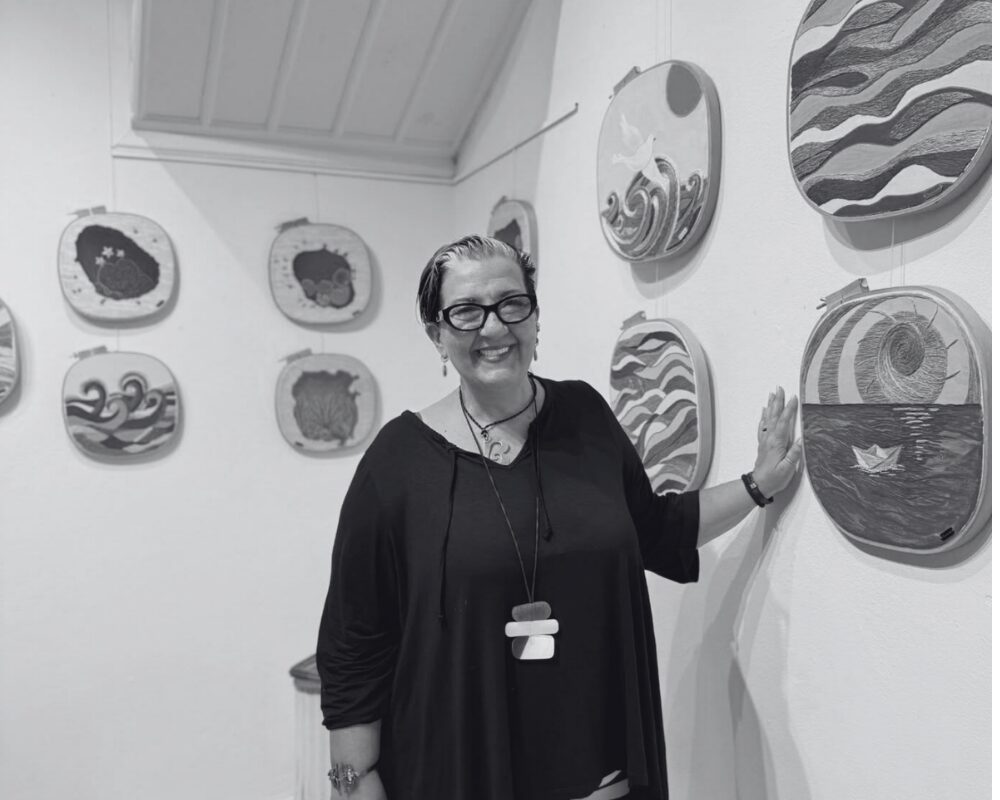
Bilek creates images with thread on embroidery hoops and sieves, produces ceramic tile works and transforms human experiences into books. Although these forms of expression may appear different, they are all nourished by the same source: people, memories, small details from everyday life and emotions that often remain unspoken.
We spoke with Benan Bilek about her embroidery and tile works, her relationship with traditional art and the literary world behind her books.
How did you begin working with embroidery hoops and sieves?
Embroidery hoops are objects many of us recognise from childhood, family homes and older generations. The sieve has a different association. Once it has completed its purpose, it is usually put aside. There is even a Turkish expression about sifting the flour and hanging the sieve on the wall, suggesting that the object has become useless.
When I looked at a sieve, however, I did not see only a tool used to separate flour. I saw a delicate surface, a circular frame and a natural space on which a story could be built. Over time, the sieve became a canvas for me, and the threads became paint.
I began bringing together different embroidery techniques, beads, lace, threads and various materials to create images on sieves. What I do is not simply embroidery in the traditional sense. It is thinking with thread, painting with thread and, at times, fitting an entire human life onto a small surface.
Does your choice of the sieve also have a symbolic meaning?
Absolutely. A sieve separates what passes through it. Some things fall away, while others remain on the surface. Life is a little like that, isn’t it? We do not carry everything we experience with the same weight. We forget certain moments, while others remain within us even many years later.
When working with sieves, I often invite people to consider one question: “What has remained in the sieve of your life?” Sometimes it is a colour, sometimes an image from childhood, sometimes a person who has been lost, and sometimes an unrealised dream.
For this reason, every piece carries traces from the life of the person who creates it. The technique can be learned, but the spirit of the work is determined by the individual’s own story.
Was this also the starting point for the Life Sieves workshops?
Yes. The Life Sieves workshops did not begin simply as places where people learned an artistic technique. They developed into shared spaces in which participants transferred colours, forms and memories from their own lives onto a surface.
Instead of saying, “Let us make a beautiful pattern,” we followed the question, “What has remained in your sieve?” Every participant worked with their own story, which is why no two pieces looked alike.
The fact that these works later contributed to social-benefit projects became a particularly meaningful part of the process. The completed sieves were exhibited in support of organisations working in education and healthcare. In this way, something that began as a personal memory was transformed into a value capable of touching another person’s life.
I do not believe that art belongs only to the artist. The moment a work is created, it begins to form a relationship with others.
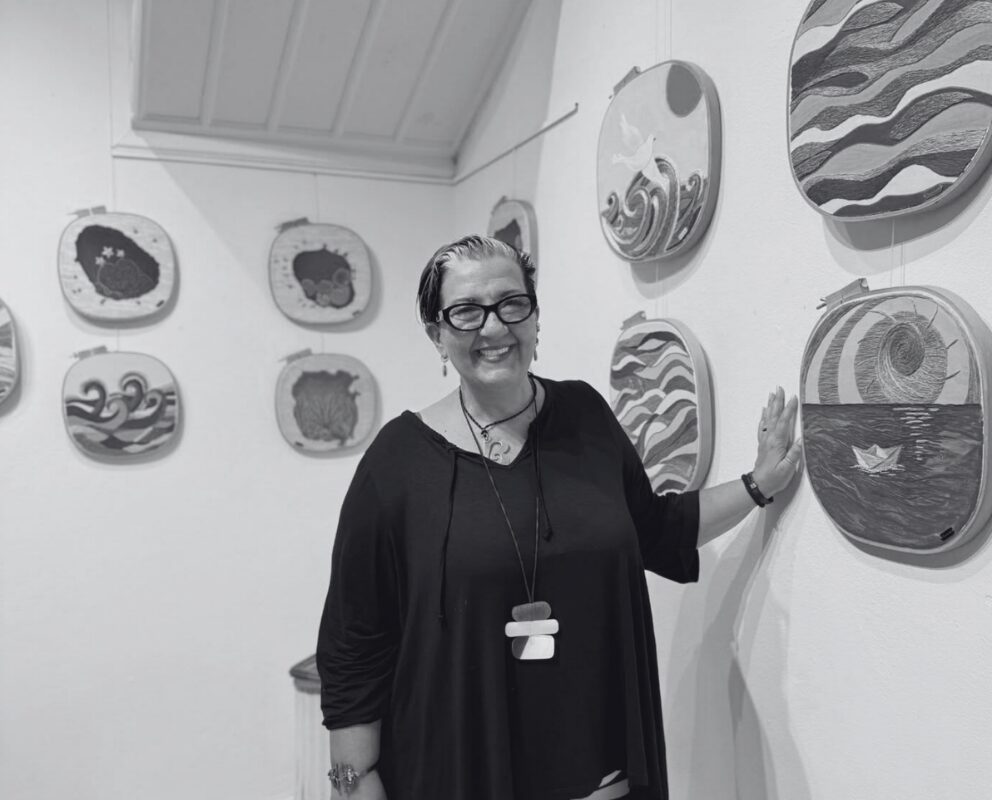
Do you mainly use traditional motifs in your embroidery works?
I draw inspiration from traditional techniques, but I do not restrict myself only to traditional motifs. Thread is an ancient material, and so is the embroidery hoop. Yet these materials can still be used to express the lives, emotions and stories of people today.
Sometimes I create figurative works, while at other times I work only through colour and form. A female portrait, a city scene, a detail from nature or a deeply personal memory can become the central element of a piece.
For me, preserving tradition does not mean repeating it without change. Allowing tradition to speak in the language of the present is also a form of preservation.
How did your relationship with ceramic tile art begin?
I encountered ceramic tile art at a very early age. I have always been fascinated by its colours, its relationship with the surface and the transformation it undergoes after firing.
When working with tiles, you are not simply creating a pattern. You must understand the material, remain patient and respect every stage of the process. The first appearance of the pigment on the surface is not the same as the final result after it emerges from the kiln. In a sense, fire has the final word.
In this respect, tile art also teaches people to accept what they cannot fully control. You do everything you can: you draw the line, place the colour and then surrender the piece to the fire. The final result contains both your labour and the will of the material itself.
What affects you most in tile art: the colours or the motifs?
It is very difficult to separate the two. The depth of cobalt, the freshness of turquoise and the emphasis created by red are powerful in themselves. Yet the meaning carried by a motif through centuries is just as important as the colour.
Hatayi, penç, çintemani and various floral motifs are not merely decorative shapes. Each one is part of a visual language carried from the past into the present. As I learn this language, I also bring the people and emotions in my own life together with these motifs.
Sometimes a person’s character reminds me of a particular ceramic colour. Sometimes an experience remains in my mind like an unfinished pattern. This is precisely where the relationship between ceramic art and literature begins.
What similarities do you see between creating a tile work and writing a story?
In both, you begin with an empty surface. When writing, there is a blank page in front of you. When creating a tile piece, there is an empty form.
You then establish the main line. In tile art, the outline known as tahrir is similar to the narrative structure of a story. If the line is not established correctly, the colours may blend into one another. In a story, if the characters and the direction of the narrative are not properly constructed, the text can also lose its shape.
Then come the colours. In writing, the colours are the characters, settings, voices and details. You cannot use everything with the same intensity. Certain areas must remain open, because emptiness is also part of expression, both in literature and in ceramic art.
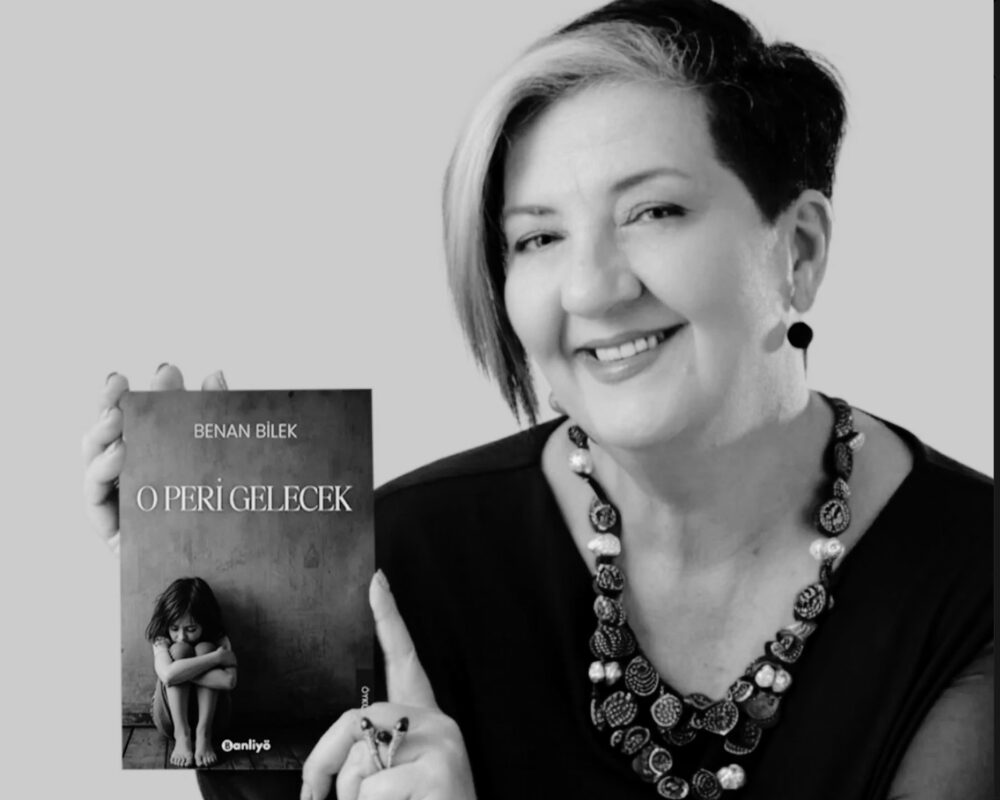
Was Çin Çin Çini Mini Hanım born from this idea?
Yes. In this book, I did not use ceramic tile art simply as a subject. I wanted to connect its production stages, colours, motifs and concepts with human stories.
I believe that every person carries a different pattern within them. Some people have very clear lines, while the colours of others emerge only over time. Some people, just like an old tile, become more meaningful through the small cracks they carry.
In the stories, I created connections between ceramic terminology and human emotions. Concepts such as tahrir, cobalt, hatayi, penç and çintemani did not remain technical headings. They became doors opening into the lives and inner worlds of the characters.
I wanted to create a book in which readers familiar with tile art could notice deeper details, while those unfamiliar with it could still enter that world through the stories.
Why are human stories so central to your work?
Because I have always been interested in people. I believe that an apparently ordinary life can carry an extraordinary number of stories.
For many years, I conducted interviews and worked in writing, advertising and communications. Every person I listened to showed me that there is always more than what appears on the surface. Sometimes a single sentence can become the beginning of a story. Even the way a person moves their hand can reveal something about their character.
In embroidery, ceramic art and literature, I am essentially doing the same thing: trying to make visible those parts of people that are not easily noticed.
What kind of literary world do Gece Tuşları and Duvarlar Şahit create?
Both books explore emotions hidden within everyday life. I am interested in the things people do not say but continue to carry: what walls have heard, what the night reminds us of, and the sentences that emerge in the mind when a person is alone.
I do not believe that great stories emerge only from major events. Sometimes a kitchen table, a door left open or a small object preserved for years can reveal an entire past.
There is both humour and sadness in my stories, because life is never made of a single emotion. We may encounter a comic detail during our most painful moment, or feel profound loneliness in a place that appears full of joy.
How does Punta – Bir Meyhanenin Romanı differ from your other books?
Punta is a novel centred on a tavern, but it is really about people, changing times, friendship and the transformation of urban life.
Taverns are not simply places where people eat or drink. They are places where people speak, remain silent, wait, long for someone and sometimes reconstruct themselves. These places have a particularly important position in the cultural memory of İzmir and Alsancak.
In the novel, I wanted to bring together the spirit of the period, its music, its tables and its human relationships. It was important to me that readers should not merely follow the events, but feel as though they were sitting at one of those tables.
What direction did you take in books such as Rezene, Limon Çekirdeği and Küçürek Bir Aşk?
Every book has its own voice, but people remain at the centre of all of them.
Sometimes a taste, a scent or a very small object can open the door to the past. Fennel or a lemon seed may seem simple and ordinary at first. Yet this is where the power of literature lies. A small detail can carry a person’s childhood, loss, love or entire life.
In Küçürek Bir Aşk, I moved towards a more concentrated and compressed narrative. I wanted to create a broad emotional space with very few words, much like seeing the traces of a large pattern in a small fragment of ceramic tile.
Do you feel more free when writing or when creating a visual work?
The form of freedom changes.
When writing, I can move beyond the limits of time, place and reality more easily. I can take a person into the past, create an encounter that never happened or pass through years in a single sentence.
In embroidery and ceramic art, however, the material creates its own boundaries. Thread tells you one thing, while the surface demands another. Ceramic pigment and the kiln establish their own rules. Yet these limits do not reduce creativity. On the contrary, they encourage you to discover new solutions.
I do not see writing and visual production as competing fields. One nourishes the other. While creating a tile work, I may think of a new story. While writing a character, I may imagine the colours from which that person is made.
How would you describe your creative practice in a single sentence today?
I try to make visible the things that pass through people’s lives and remain behind, sometimes through thread, sometimes through ceramic pigments and sometimes through words.
From Thread to Pattern, From Pattern to Sentence
In Benan Bilek’s creative world, traditional arts are not treated as untouchable practices belonging only to the past. They are living languages capable of telling new stories.
In her hands, sieves cease to be ordinary household objects that have completed their function. They become surfaces carrying personal memories. The embroidery hoop is no longer only a tool for needlework, but a circular frame on which images can be created with thread. Ceramic tile art, meanwhile, becomes a language of motifs, colours, human character, fragility and transformation through fire.
A similar approach can be seen in Bilek’s books. Small details expand, everyday objects open the doors of memory and apparently ordinary lives become layered narratives.
Across her work, there is a continuous movement between thread and sentence, pattern and character, ceramic surface and printed page. The one element that never changes is the human story at the centre.